

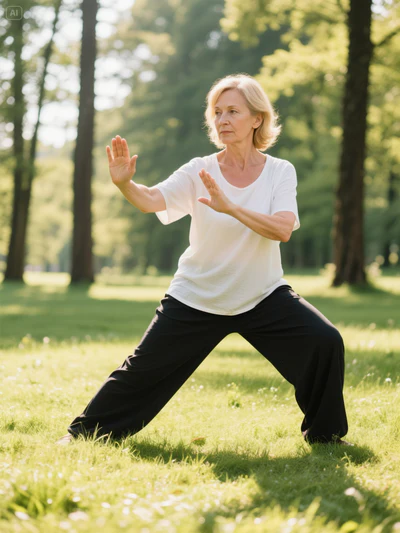
My journey with Tai Chi began with a simple curiosity. I had seen people practicing slow, flowing movements in parks and videos, and I assumed it was only a gentle exercise for relaxation. What I didn’t know then was that Tai Chi is far more than a set of movements—it’s a deep, inward journey, a practice that reshapes both body and mind.
1. From Copying Movements to Understanding Them
In the beginning, I was focused entirely on external form—how high my hands should be, how wide my stance should look, how far my weight should shift. Every detail felt like a technical formula that I needed to solve correctly.
I wasn’t practicing Tai Chi; I was just performing gestures.
One day, my teacher said, “Tai Chi should flow like water. When you relax, you can move.”
That sentence struck me. I suddenly realized how tense my shoulders were, how stiff my back felt, how my entire body was fighting itself.
Slowly, I learned to release my obsession with “perfect posture.” Instead of forcing shapes, I started paying attention to sensations—the grounding of my feet, the softness of my shoulders, the warmth of my breath. As my body relaxed, my movements began to flow naturally, smooth and effortless, like water moving downstream.
For the first time, I felt that I had stepped through the real gate of Tai Chi.
2. From External Shape to Internal Awareness
The most essential principle of Tai Chi is song, often translated as “relaxed openness.”
But “relax” doesn’t mean going limp. It means letting go of unnecessary tension so inner strength can rise from the ground up.
I still remember the first moment I truly felt “song.”
It happened during the movement Cloud Hands.
As my body shifted from side to side, I noticed my shoulders were no longer rigid, my breath flowed gently between my chest and abdomen, and my arms felt as if they were being carried by the air, not by muscle force.
That was the moment I understood that Tai Chi isn’t just about movement—
It’s about awareness.
Tai Chi taught me to feel:
Is my breath tight today?
Is my back stiff?
Is my mind restless?
Every posture became a mirror, reflecting the state of my body and the state of my heart.
3. From Chasing Progress to Following the Breath
One of the biggest mistakes I made in the beginning was wanting to improve fast.
I wanted to learn forms quickly, master techniques quickly, and see results quickly.
But Tai Chi is never rushed.
Just like a tree, it grows quietly, slowly, layer by layer.
What transformed my practice was understanding the rhythm of breath.
When movement matches breath, the whole body feels connected:
Inhale—energy rises gently from the ground.
Exhale—tension melts away like a soft wave returning to the sea.
Before, my body moved but my mind wandered.
Now, when I practice, my breath becomes my anchor.
The slower I move, the clearer I feel.
The deeper I breathe, the calmer I become.
Tai Chi taught me that speed is not strength.
Stillness is strength.
4. From Training the Body to Training the Mind
Physical improvements are only the beginning. Over time, Tai Chi began shaping my mindset in ways I never expected.
Tai Chi taught me:
- Rushing doesn’t solve anything.
- Force doesn’t create real power.
- The more anxious you are, the easier you lose balance.
- Strength comes from softness, not tension.
In life, just like in Tai Chi, everything follows a cycle of expansion and contraction.
There are moments to advance, and moments to pause.
Moments to hold your ground, and moments to let go.
I started applying Tai Chi principles to daily life:
When stress rises, I remind myself to sink the breath.
When emotions flare up, I pause and find my center.
When problems feel overwhelming, I stay grounded before taking action.
Tai Chi teaches the art of living—
A calm body, a calm mind.
A steady posture, a steady heart.
5. Tai Chi Has No End—Only Depth
Tai Chi does not promise instant transformation. You won’t become stronger overnight, and you won’t master the forms in a week. But Tai Chi grows with you, quietly, subtly, and powerfully.
One day, you realize your shoulders no longer ache.
Another day, you notice you sleep better.
Then you realize you handle stress with more clarity and patience.
These changes come not suddenly, but consistently.
Tai Chi isn’t about competing, showing off, or rushing.
It’s about meeting yourself, every day, with softness and honesty.
It is ancient, but it fits modern life.
It uses no equipment, but it strengthens you from the inside out.
It is slow, but it reveals deep, hidden power.
Tai Chi is not just a practice—it is a lifelong companion.
A quiet teacher.
A mirror to the soul.